



















Choosing between a shrink sleeve and a pressure-sensitive label involves more than appearance. Container shape, application equipment, run size, and end-of-life requirements all affect the decision. Check these before approving artwork or tooling.
Shrink Sleeve vs Pressure Sensitive Label at a Glance
A shrink sleeve is a printed plastic tube slipped over the container, then heated so it contracts and hugs the contours. You can use it for wraparound decoration. A pressure-sensitive label is printed facestock with adhesive already on the back, applied flat to one or more panels with pressure. Sleeves can provide broad coverage and may suit contoured containers. Pressure-sensitive labels can offer setup flexibility and tactile finishes; the trade-offs depend on the supplier, package, and line.
Four inputs settle it faster than comparing price per label: container shape, how much print coverage you need, run size per SKU, and where the container is meant to end up in the recycling stream.
Price per piece is the last input, not the first.
| Factor | Shrink sleeve | Pressure sensitive label |
|---|---|---|
| Coverage | Wraparound coverage; a seam may be visible depending on construction and application | Defined panel, front and back, or a wrap |
| Container shapes | Tapered, waisted, ribbed, compound curves | Cylinders, straight-wall jars, flat panels, gentle tapers |
| Application | Sleeve applicator plus steam or hot-air tunnel | Label applicator, pressure only, no heat or water |
| Tooling and setup | Print setup, seam setup, artwork distortion proofing, applicator change parts per container diameter | Cutting die per label size and shape |
| Run size sweet spot | May suit medium-to-high volume per SKU; compare setup and unit costs | May suit shorter runs or frequent SKU changes; confirm quote and line fit |
| Look on shelf | Wraparound graphics; seam visibility depends on construction and application | Paper and textured stocks, clear no-label look, foil, embossing |
| Recyclability | Depends on film type, coverage, and whether it separates | Depends on facestock and adhesive pairing |
| Changeover | May require format-specific setup or change parts | May be quicker for roll changes; confirm equipment requirements |
A brand can use both formats across a product line, for example, a sleeve on a contoured container and a pressure-sensitive label on a straight-wall jar. Compare the needs of each SKU rather than assuming one format must serve every package.
What a Shrink Sleeve Actually Is
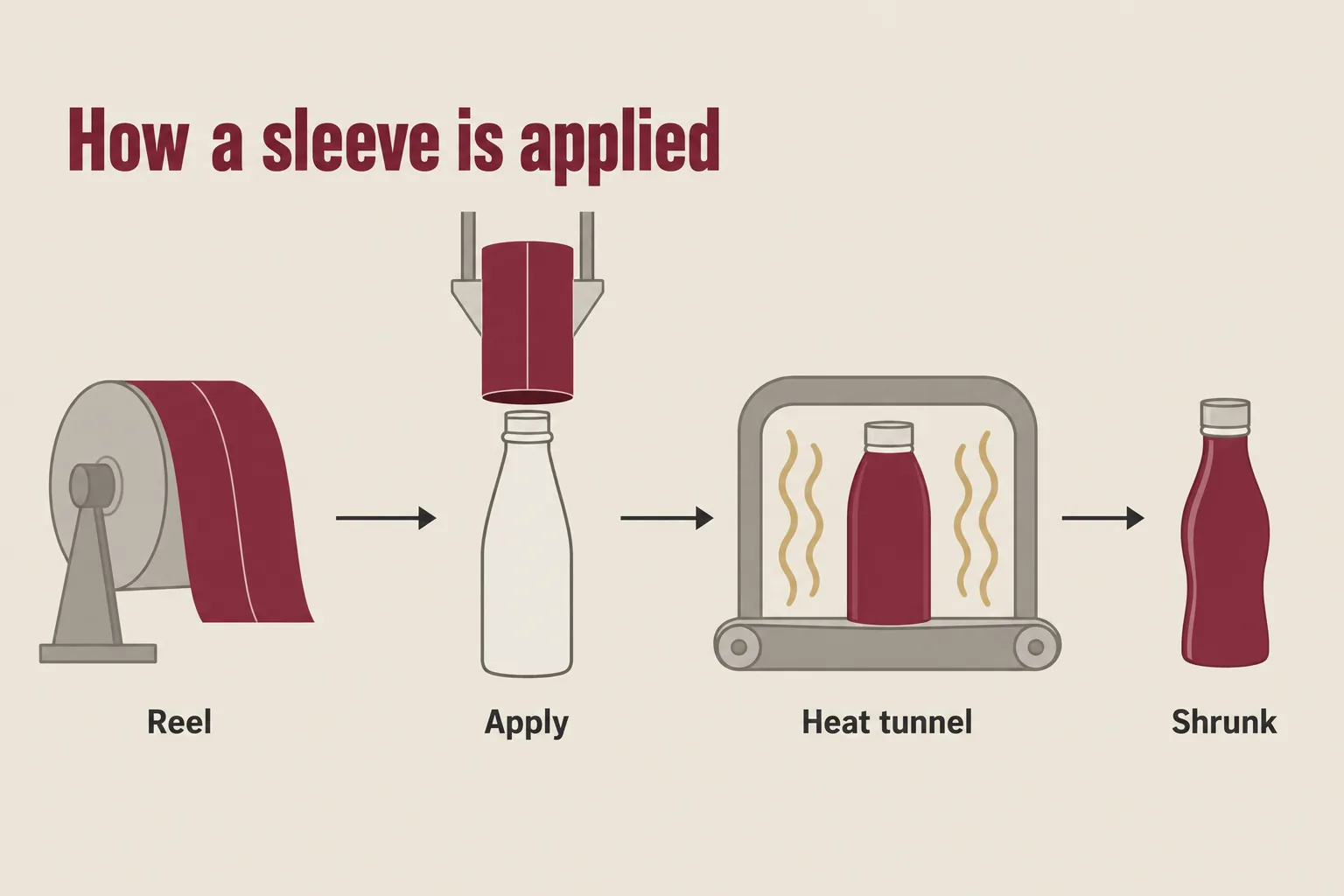
The sleeve arrives as a flat, printed, seamed tube on a reel. An applicator opens it, drops it over the container, and a steam or hot-air tunnel does the rest. The film contracts around the container shape, which may help on contours where a pressure-sensitive label could wrinkle or bridge. Confirm fit with a physical sample.
Many sleeve constructions use reverse-printed film, which can help shield the ink from surface scuffing. Actual print durability depends on the film, inks, application, and distribution conditions; confirm it with a sample test.
Film types you will hear about:
- PETG, OPS, and PVC are among the film options a supplier may discuss. Shrink performance, application conditions, container compatibility, and recycling implications vary by grade and package.
- Bio-based films also require product-specific review. Confirm material performance and the intended recovery route with the supplier; a bio-based claim alone does not establish recyclability or compostability.
Sleeves are not only full body. You can run a partial sleeve as a band around the middle, a tamper-evident neck band on a juice or kombucha bottle, or a construction that decorates the body and seals the closure in one pass.
Before artwork is approved, confirm whether the production site has the sleeve applicator, heat tunnel, and space the format requires. If not, ask about a qualified co-manufacturer or another application option.
What a Pressure Sensitive Label Actually Is
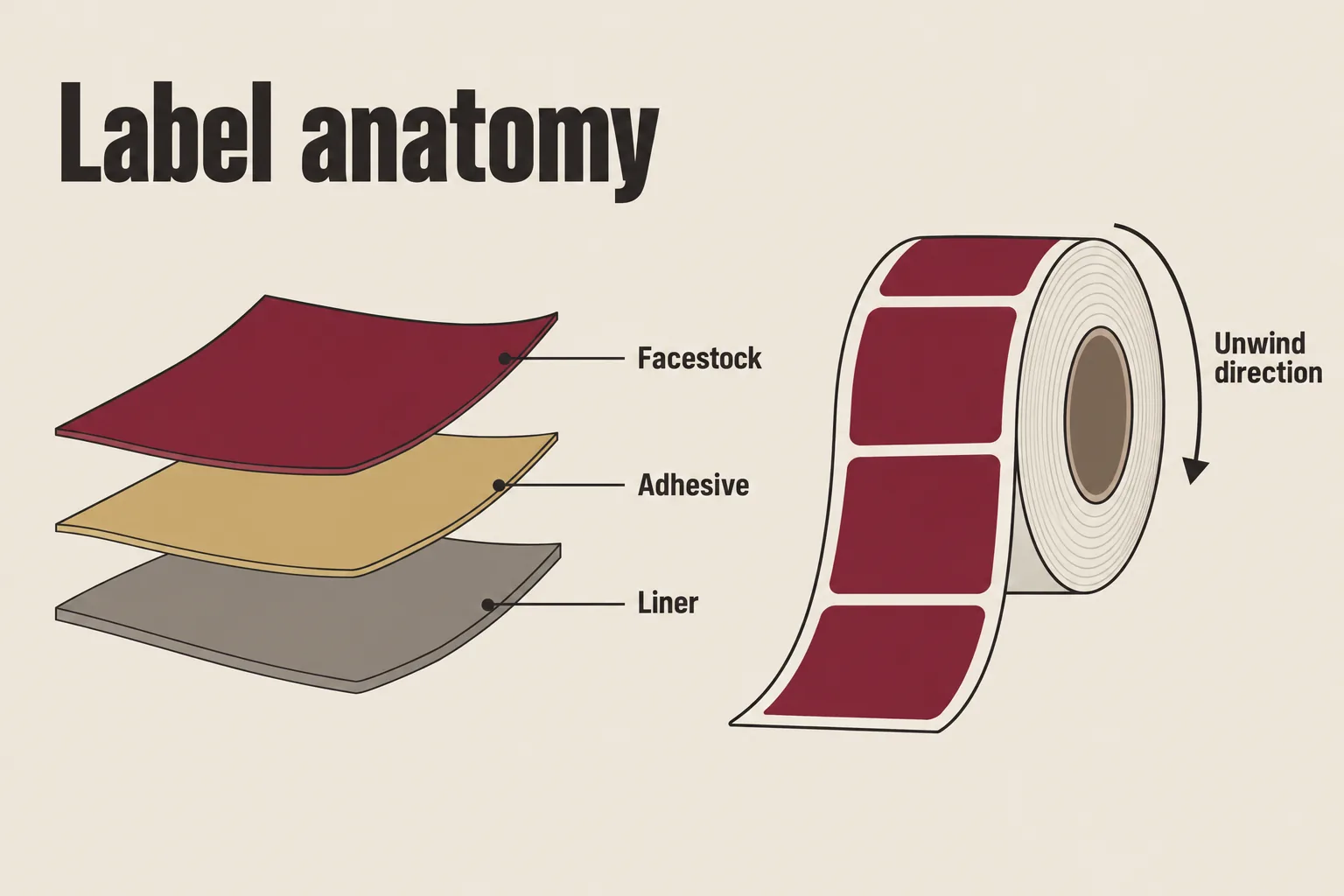
Three layers: facestock, adhesive, liner. The label is cut to shape on the liner, delivered on a roll, and applied with pressure. No heat, no water, no glue pot, no drying.
Facestock sets the shelf message:
- White film stock for durable, moisture-tolerant, everyday decoration.
- Clear film stock for a no-label look on glass and clear plastic; the final appearance depends on the container, adhesive, and label construction.
- Paper and textured paper for craft and premium positioning, common on specialty beverage and small-batch bakery.
- Metallized stocks for shine without a separate foil pass.
Adhesive choice can be as important as facestock selection. Permanent, removable, all-temperature, freezer-grade, and wet-surface adhesives all behave differently. A beverage that lives in an ice bucket, or a frozen snack labelled while cold, needs an adhesive built for that, not a standard permanent.
Pressure-sensitive labels can support finishes such as matte or gloss varnish, soft touch, spot gloss, cold foil, and embossing, depending on the supplier and construction.
One practical detail derails first runs more than any other: roll format. Unwind direction, core size, roll diameter, and labels per roll all have to match the applicator that is physically on the line at your facility or co-packer. A perfect label wound the wrong way is a stopped line.
Head-to-Head: The Decisions That Actually Settle It
Work through these in order.
Container Shape and Contour
Sleeves conform to tapered, waisted, ribbed, and compound-curve containers where a flat label would bridge the gap, wrinkle, or lift at the edges. Pressure-sensitive labels often suit cylinders, straight-wall jars, flat panels, and gentle tapers, provided the label shape, adhesive, and applicator are matched to the package.
Squeeze bottles and thin-wall containers need a trial. A sleeve or label may affect squeezing, fit, or appearance; test the chosen construction on the actual container and application line.
As an initial screen, a changing circumference may make a sleeve worth evaluating. Confirm the choice with a physical sample and the production line.
Choose sleeve if the container has real shape to it. Choose pressure sensitive if the label zone is effectively straight.
Shelf Impact and Print Coverage
A sleeve can provide wraparound coverage, although the seam and its placement may be visible. That helps bold colour blocking on a crowded snack or beverage shelf, where shoppers see the product at an angle.
The major benefit of a shrink sleeve is that the labels provide the can with 360-degree graphic coverage whereas the adhesive label can only …Read on Reddit ↗
Pressure sensitive gives you a defined panel and tactile finishes sleeves struggle to match, including uncoated textured stock and embossing. Clear facestock delivers the no-label look that matters in premium juice and craft beverage.
Sleeves add one step: artwork has to be stretched in advance so the design lands correctly once the film contracts. That means an art preparation stage and a physical shrunk sample on the real container before anyone signs off.
Choose sleeve if full-coverage graphics are the selling point. Choose pressure sensitive if texture, foil, or the clear look carries the brand.
Run Size, Tooling, and What the Unit Price Hides
Pressure-sensitive labels may require a cutting die for each label shape and size. Setup and change costs depend on the converter, material, run length, and artwork changes, so confirm them in the quote.
Sleeve setup may include seam and distortion proofs, as well as format parts for the applicator. Requirements vary by supplier and line; request a complete setup-cost breakdown.
At some volume levels, a sleeve may have a lower per-unit cost than a pressure-sensitive label, but there is no universal crossover. Compare material, setup, application, changeover, scrap, and inventory costs for each SKU and volume tier.
The number that decides it is landed cost across the program: application labour, tunnel energy, scrap rate, changeover time between SKUs, and the obsolescence risk when a claim or recipe changes mid-year. A per-piece price quoted on one item in isolation hides all five. Model the full SKU list at realistic volume tiers instead.
Speed, Application, and Co-Manufacturer Constraints
Pressure-sensitive application is available in manual, semi-automatic, and automatic setups. Confirm which equipment the selected co-packer has and whether it matches your container and required line speed.
Also, pressure sensitive labeling after filling is preferred, since labeling before filling could cause issues with can roundness, lid fitment, …Read on Reddit ↗
Sleeve application requires compatible equipment and floor space. Before artwork is approved, confirm what the co-manufacturer can run and whether outside application or equipment investment would be needed.
Depending on package and supplier capability, manual application or outsourced sleeving may be options for trials or limited runs. Confirm fit, appearance, throughput, and cost before choosing them for production.
Watch heat-sensitive products. The tunnel puts heat on the container and, briefly, on the contents. That matters for chocolate coatings, some ready meals and certain beverages, and it is worth a trial rather than an assumption.
Durability: Moisture, Freezers, Ice Buckets, and Distribution
With some reverse-printed sleeve constructions, the film can protect the ink from direct surface contact. Test the complete package under expected condensation, cold, and handling conditions before relying on that benefit.
Pressure sensitive durability comes down to the facestock and adhesive pairing. Film facestock with an adhesive matched to the surface handles wet, frozen, and oily conditions. A mismatch between adhesive, container surface, application temperature, or service conditions can contribute to edge lift. Ask the label supplier to recommend and test a suitable facestock and adhesive combination.
Distinguish application temperature, the condition of the container and work area when the label is applied, from service temperature, the conditions it experiences afterward. Confirm both against the product and supply chain.
Recyclability and the Sustainability Trade-Off
Recycling considerations are one reason a brand may revisit a decoration choice.
A sleeve can affect sorting and recycling, but the result depends on the container resin, sleeve and ink materials, coverage, separation behavior, and local recycling process. APR guidance recommends assessing the complete package design rather than assuming a sleeve is recyclable or incompatible based on material name alone.
Potential design options include sleeves that separate during recycling, perforations, reduced coverage, or label-and-adhesive combinations designed for the target stream. Suitability must be checked for the specific container and recycling system; none of these features alone guarantees recyclability.
Identify the intended recovery stream before final artwork and tooling. Recycling access and accepted package designs can vary by market, so verify any environmental claim and local guidance before printing it on pack.
Regulatory and Label Space Pressure in Canada and the United States
Required label content and available display area can affect the decoration choice. In Canada, many consumer prepackaged foods require English and French information, subject to exemptions. As of January 1, 2026, front-of-package nutrition symbols apply to most in-scope foods that meet specified nutrient thresholds, with exemptions. Review current CFIA bilingual labelling guidance and Health Canada’s front-of-package symbol guide.
Sleeves can provide more printable area, while extended-content pressure-sensitive labels may add panels. Neither format guarantees regulatory compliance; confirm required content, placement, legibility, and market-specific rules with a qualified label reviewer.
The United States and Canada have different labelling rules. FDA’s front-of-package nutrition box is a proposal in the latest FDA update, while Canada’s applicable FOP requirements took effect in 2026. Check the current FDA front-of-package nutrition labelling update and the rules for the specific product and market before approving artwork.
Where Each Format Wins by Product Category
Specialty beverages, juices, and alternative canned drinks. Sleeves may suit contoured bottles or packages needing wraparound graphics. Pressure-sensitive labels may suit glass bottles where paper or tactile finishes are part of the design. Confirm container compatibility, line capability, and run economics for each SKU.
Craft brewery. Pressure-sensitive labels may suit frequent artwork changes and smaller runs. A sleeve may be worth comparing for a stable, higher-volume SKU or a package needing more coverage; actual economics depend on the supplier quote and line.
Protein, breakfast and nut bars. Graphics usually live on printed film wrap rather than either label format, with pressure sensitive used on multipack cartons and club packs, and for variable data.
Chips, popcorn and cookies. Printed film and pouches carry the brand. Pressure sensitive shows up for best-before coding, promotional overlays and short-run flavour tests where new film tooling is not justified.
Brownies and bakery in clamshells and trays. Pressure-sensitive labels may support product identification or a tamper-evident feature when designed for that purpose. Confirm the closure function and application with the package supplier.
Decoration rarely stands alone. It sits inside a broader pack decision covering film, folding carton, corrugated tray and retail display, and the colour has to match across all of them.
A Practical Way to Decide Without Guessing
- List every container and confirm shape, material and fill temperature.
- Confirm what your co-manufacturer can run today, and what would need capital or outsourcing.
- Map SKU count, forecast volume per SKU, and how often artwork realistically changes.
- Define the end-of-life target and any retailer sustainability requirements you have already signed up to.
- Request comparable quotes by SKU and volume tier using the information in the checklist below.
- Run a physical trial on the actual line, with real containers, before committing to full tooling.
Armour Rose’s stated approach begins by understanding the customer’s packaging needs before proposing a solution. Its sourcing and brokering service is relevant when comparing options across suppliers and production partners.
What to Include in a Label Quote Request
Share the container material and dimensions, label area, fill and application conditions, expected service conditions, volume by SKU, artwork-change frequency, and co-packer equipment details. If recyclability is a requirement, specify the target market and recovery stream. These details help suppliers quote comparable constructions and setup costs.
Common Mistakes Brands Make When They Switch Formats
- Approving sleeve artwork on a flat proof instead of a shrunk sample on the real container. Flat proofs never show what the contour does to a logo.
- Choosing the decoration format before confirming the filling and application equipment.
- Quoting on unit price alone, then meeting the labour, scrap and changeover costs after the first production run.
- Sourcing each format from a different vendor without aligning colour targets, specifications, and delivery timing across the pack.
- Locking artwork before the sustainability and regulatory review is done.
- Ordering volumes that do not match real velocity, which leaves you with obsolete inventory the moment a claim or recipe changes.
How Armour Rose Helps You Make and Execute the Call
Armour Rose sources custom packaging through manufacturing partners and offers label and shrink-sleeve solutions as part of its broader packaging work. Its consultative approach starts by understanding the product, packaging requirements, production setup, and order needs before discussing options. Explore Armour Rose’s label and shrink-sleeve solutions.
The company’s broader packaging offer includes printed film, folding cartons, corrugated trays and displays, pouches, and labels. A single packaging discussion can help a brand consider how those items fit together, while each specification and production capability should be confirmed with the relevant partner.
Armour Rose’s company overview describes more than 20 years of experience serving food and beverage brands in Canada and the United States. The company reports that February through April are slower months for its own business; production-trial timing still depends on manufacturing-partner and co-packer availability.
To compare formats for your SKU list, contact Armour Rose to discuss your current container, line, and volume requirements.